---
title: "Install on Divi"
description: "Put the support chat on a Divi 5 or Divi 4 site with the tufu AI plugin, add the Ask console in a Code module, or paste the snippets in Theme Options."
url: https://tufu.ai/docs/divi/
---
# Install on Divi
Put the support chat on a Divi 5 or Divi 4 site with the tufu AI plugin, add the Ask console in a Code module, or paste the snippets in Theme Options.
Divi is a WordPress theme, so the quickest way to put tufu on a Divi site is the free **tufu AI** plugin: no code to
paste, and nothing to redo when Divi updates. This page covers the plugin, what's particular to Divi (the Visual
Builder, the Ask console in a layout, Divi's performance settings), and the snippets in Theme Options if you'd rather
not add a plugin. It works the same on Divi 5 and Divi 4.
## Before you start
- You need to be an administrator of the WordPress site, and an admin of your team in tufu. No tufu account yet? You
can create a free one while you connect.
- The plugin needs WordPress 6.5 or newer, and PHP 7.4 or newer.
## 1. Install the plugin
In WordPress, go to **Plugins → Add New Plugin** and search for **tufu AI**. Press **Install Now**, then
**Activate**.
## 2. Connect to tufu
Go to **Settings → tufu AI** and press **Connect to tufu**. Sign in, or create a free account, pick the bot your
site should show, and press **Connect**. You're back in WordPress with the bot saved.
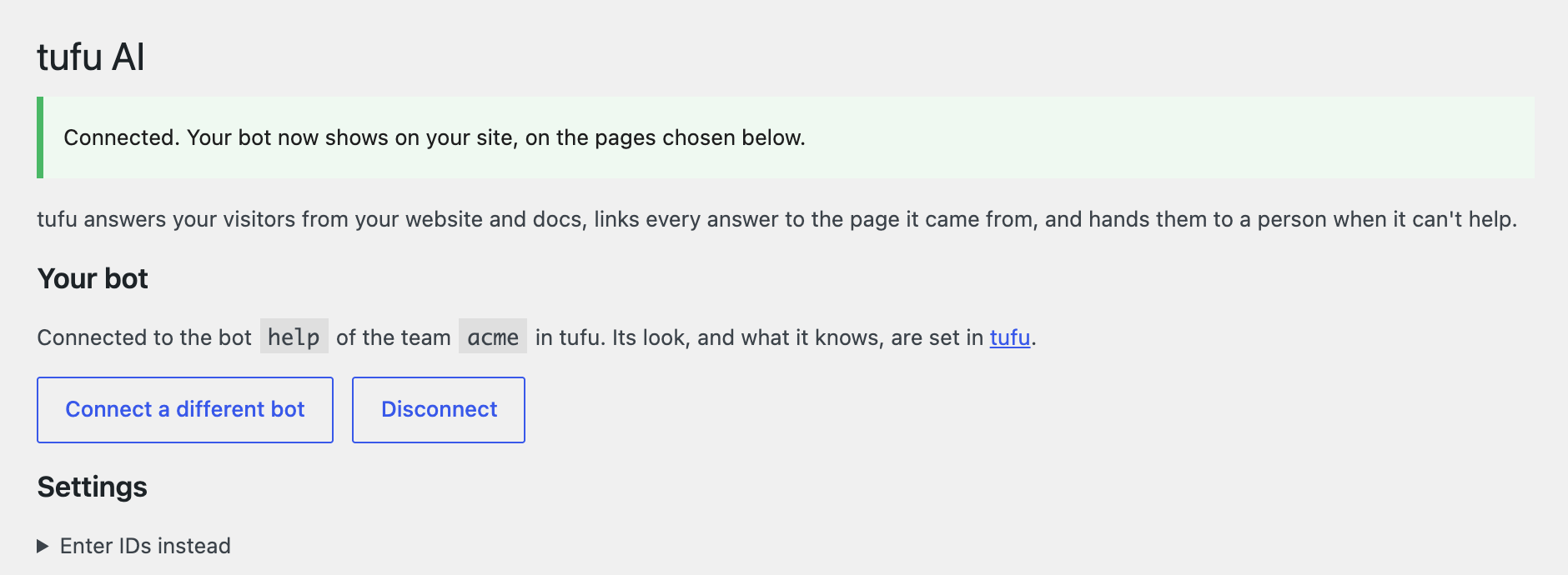
The details of each step (making a private bot public, a bot's allowed websites, typing the IDs instead) are in
[Install on WordPress](https://tufu.ai/docs/wordpress/).
## 3. Check it on your site
Open a page of your site the way a visitor would, **not** in the Visual Builder: the chat button is in the corner.
**Check it's live on tufu** in **Settings → tufu AI** opens the bot's **Put it on your site** page, which turns to
"Live on" your site the first time the chat loads there.
## The chat and the Visual Builder
Divi's Visual Builder edits your page on the front end of the site, so to WordPress it looks like a visitor's page.
From plugin version **0.6.2** the chat bubble stays out of it, so it never covers your module settings or the
builder's buttons. Exit the builder (or open the page in another tab) and the bubble is there.
The same goes for the editors of Elementor, Beaver Builder, Bricks and Oxygen, if you use one of them alongside or
instead of Divi.
On an older version of the plugin, update it under **Dashboard → Updates**, or turn on **Hide the chat bubble from
logged-in admins** in **Settings → tufu AI** while you design.
## The Ask console in a Divi layout
The Ask console is a search box that answers from your knowledge, handy on an FAQ, help or pricing page. The Visual
Builder doesn't use WordPress blocks, so add it with the shortcode:
Open the page in the Visual Builder, add a **Code** module where the box belongs, and in its **Content** tab, under
**Code**, type:
```text
[tufu_ask]
```
Save the page and exit the builder to try it.
The shortcode takes the same options as anywhere in WordPress: `[tufu_ask placeholder="Search our services"]` changes
the text in the box, and `hotkey=""` turns off the Cmd or Ctrl + K shortcut. To show it on every page, put the Code
module in a header or footer template under **Divi → Theme Builder**.
## Divi's performance settings
Divi can defer scripts and load its own JavaScript only where it's needed (**Divi → Theme Options → General →
Performance**). Leave those as they are: tufu's script already runs after the page, as a module.
What can stop the chat is an optimization plugin that **combines** or **delays** JavaScript (WP Rocket, LiteSpeed
Cache, Autoptimize and the like): exclude `tufu-chat.esm.js` in its JavaScript settings. After any change, clear that
plugin's cache and your host's page cache. More in [Install on WordPress → Troubleshooting](https://tufu.ai/docs/wordpress/#troubleshooting).
## Without the plugin: Theme Options
If you'd rather not add a plugin, Divi's **Integration** tab puts code on every page of the site. Copy the two lines
from your bot's **Put it on your site** page in tufu (they have your team and bot IDs filled in; below they're
`your-team` and `your-bot`).
Go to **Divi → Theme Options** and open the **Integration** tab. Turn on **Enable header code** and paste the script
in the box for the ``:
```html
```
Turn on **Enable body code** and paste the chat element in the box for the ``:
```html
```
Press **Save Changes**, then open your site.
Snippets pasted this way show in the Visual Builder too, and they don't sign in logged-in visitors or answer
WooCommerce order questions: those need the plugin. Use one route or the other, not both, or the chat loads twice.
## Teach the bot your site
Under **Knowledge**, add a **Website** source with your sitemap. WordPress publishes one at
`https://yourdomain.com/wp-sitemap.xml`; an SEO plugin (Yoast, Rank Math and the like) usually replaces it with its
own, often `sitemap_index.xml`. Either works. See [Knowledge](https://tufu.ai/docs/knowledge/).
## Troubleshooting
- **The bubble doesn't show on the live page.** Check you're not in the Visual Builder, then the list in
[Install on WordPress → Troubleshooting](https://tufu.ai/docs/wordpress/#troubleshooting): the **Show the chat bubble** setting,
the bot's **Where it appears** page, caching, Cloudflare Rocket Loader.
- **The chat shows twice.** The snippets are in Theme Options **and** the plugin is connected. Remove one: turn off
**Enable header code** and **Enable body code**, or disconnect the plugin.
- **The Ask box shows the text `[tufu_ask]`.** The plugin isn't active or connected, or the shortcode is in a module
that doesn't run shortcodes. Use a **Code** or **Text** module.